The videos cover volume, definition, bangs, care routines, tools and moisture, and the right one depends on your hair’s current state: dry or damaged curls need the moisturizing videos first, while healthy curls that fall flat want the volume or definition tutorials.
Bangs narrow it further, since the curly bangs tutorial is the only one built around a specific cut.
The detail that sets this list apart is the Denman-style brush, which shapes curls on wet, product-coated hair and also styles curly bangs.
1. Volume Techniques

Volume in curly hair comes mostly from the roots, and that is where I would put my effort.
Flip your head upside down while the hair is damp and scrunch upward toward the scalp, so the curls dry lifted instead of flat against your head.
A diffuser on low heat keeps the curl pattern intact while it sets that lift. Once the hair is fully dry, fluff gently with your fingers at the crown rather than brushing, which would pull the curls apart into frizz.
Volume techniques ask for some patience at the root, since lifted curls need clips or a diffuser held in place while they set.
2. Defined Curls Tutorial

Tight, defined curls start with sections. Working through the hair in small pieces lets product coat every curl evenly, and that is what separates a clean spiral from a loose, frizzy wave.
I like to apply styler on soaking wet hair, then scrunch upward and leave it alone.
Touching curls while they dry breaks up the clumps you just built. Wait until the hair is completely dry, then gently scrunch out any stiff cast.
Long hair like this needs patience more than product. Expect the full routine to take a while, and I would rather do it carefully once than rush it twice.
3. Styling Curly Bangs
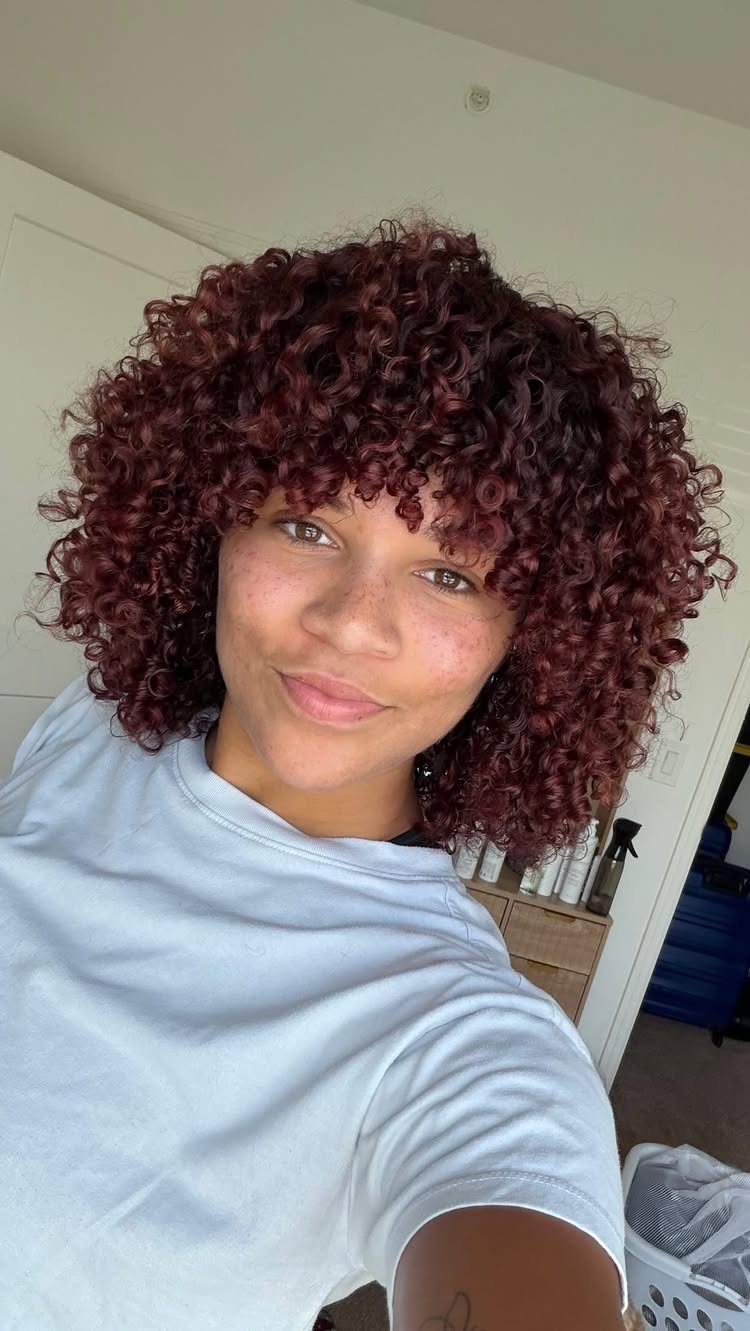
Curly bangs behave best when they get their own mini routine, separate from the rest of the hair. Wet them down on their own, add a small amount of curl cream, and let them settle into their natural pattern.
Keep the product light, since bangs sit right against the forehead and heavy gel will weigh them flat. I would also resist the urge to restyle them throughout the day; one pass, then hands off.
Curls spring up as they dry, so they end up shorter than they look wet. Have them cut dry, or leave a bit of extra length.
Hair Care Routines
Consistency does more for curls than any single product. A routine you repeat on every wash day, in the same order, gives you results you can read and adjust, which a rotating set of experiments never does.
Keep it simple at first: cleanse, condition, then style while the hair is still wet. Write down what you used and how the curls looked once dry, so you can change one thing at a time.
Even the water matters. If your curls feel dull or dry no matter what you apply, the shower water itself may be part of the problem, and a filtering shower head is worth a look.
Save your full routine for wash day and go lighter between washes. Overdoing steps is how a healthy routine turns into damage.
Styling Tools
A wide-tooth comb is the safest tool for wet curls. Work through the hair while it is soaked with conditioner, since the slip lets the teeth glide instead of snagging.
A detangling brush earns its place too, especially for shaping curls after you apply product. A Denman-style brush is the one I’d reach for to define curls, and it is also the tool for curly bangs.
Use whichever tool you pick only on wet, product-coated hair. Pulling either one through dry curls breaks up the pattern and invites frizz.
Start at the ends and work upward in small sections. It takes a few extra minutes and saves a lot of breakage.
Moisturizing Techniques
Dry curls look frizzy and lose their shape, so moisture is the base of everything else. A curl cream is the easiest way to add it: it softens the curl, cuts frizz and dryness, and leaves a glossy finish.
It is especially useful on damaged hair, where the cuticle is rough and loses water fast. Apply it on wash day while the hair is wet so it can seal in that water.
Start with a small amount and add more only where the hair still feels dry. Too much cream weighs curls down and leaves them limp.
If your curls feel stiff or straw-like despite regular cream, your routine probably needs more water first, not more product.
Frequently Asked Questions
What are the best products for curly hair?
A curl cream is the easiest place to start. Curls come out softer and less frizzy, with a glossy finish and less dryness, and damaged hair benefits most.
On wash day, work a small amount into soaking wet hair so water stays locked in, and add more only to spots that still feel dry.
Stiff, straw-like curls usually mean the hair is short on water, so skip the extra product and add moisture.
How can I achieve volume in my curls?
Work from the roots.
After washing and styling your curls, dry them with a diffuser on low heat to keep the pattern intact. Once fully dry, fluff the crown gently with your fingers instead of a brush, which pulls curls apart into frizz.